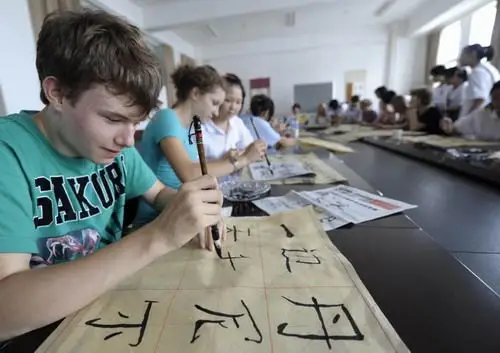
Have you been hearing the phrase "English is the most advanced language in the world" for over a decade? Since childhood, we have been instilled with the idea that "mastering English ensures you can navigate the world without fear," as if English inherently carries a "premium filter." But today, we are going to debunk this misconception: from the essence of language, English is not only not "advanced," but it also harbors many "backward" flaws. In contrast, our Chinese characters have long surpassed English in dimensions such as information transmission, cognitive efficiency, and cultural heritage. Don’t believe it? Let’s present the data and facts!
Let's start with the most basic "pronunciation and spelling," which is often a "nightmare beginning" for English learners. Have you ever had this experience: seeing the letter combination "ough" and not daring to open your mouth to pronounce it? In "tough," it's pronounced /ʌf/; in "through," it's /uː/; and in "thought," it's /ɔː/. The same combination has three different pronunciations, and even native speakers have to rely on rote memorization. Even more absurd is the word "colonel," which looks like it should be pronounced "koh-luh-nel" but is actually pronounced /ˈkɜːnl/. It's truly a "major disconnect between spelling and pronunciation."
Research statistics show that approximately 70% of English words have inconsistencies between spelling and pronunciation. This means that when learners memorize vocabulary, they not only have to remember the spelling and meaning but also an additional set of "pronunciation codes," effectively doubling the memory burden. In contrast, although Chinese characters have four tones, the connection between their form and meaning is fixed. Even when encountering an unfamiliar character, one can often guess its meaning by looking at its radicals. For example, seeing the "氵" radical indicates a connection to water, while the "扌" radical is always related to actions. This advantage of "form-meaning correspondence" is simply not found in English.
Looking at word formation capability, this is the core advantage where Chinese characters "crush" English. When English encounters new things, it either creates a brand-new word or directly transliterates, resulting in a massive expansion of vocabulary. The total number of English words now exceeds one million, with 1,500 commonly used roots and 250 affixes alone. For example, for "magnetic resonance imaging," English has to create an abbreviation like "MRI," leaving non-professionals confused; whereas Chinese characters directly combine "magnetic," "resonance," and "imaging," so even if seen for the first time, the meaning is instantly understood.
How efficient is the word formation logic of Chinese characters? The International Language Association conducted an experiment: presenting 100 emerging technology terms to bilingual speakers of Chinese and English. Chinese speakers took an average of only 35 minutes to understand and apply all of them, while English speakers required over 90 minutes. More importantly, the 3,500 commonly used Chinese characters in modern Chinese can cover 99.48% of daily language materials. In other words, mastering 3,500 Chinese characters allows one to read Chinese fluently, whereas achieving the same level of reading proficiency in English requires memorizing at least 20,000 words—a significant difference.

At the grammatical level, the "tediousness" of English further exposes its "backwardness." As an inflected language, English verbs must change according to person and tense, with the verb "be" having five forms: "am, is, are, was, were." Past participles and present participles also require separate memorization. Even more frustrating are prepositional collocations, such as "in the morning," "on Monday," and "at 8 o'clock," which lack any logical basis and rely entirely on rote memorization. A foreign student once complained, "It took me three years to understand the usage of 'in, on, at,' only to realize that Chinese people simply say 'morning, Monday, eight o'clock' and get it done."
As an analytic language, Chinese, in which Chinese characters are used, has long abandoned these meaningless morphological changes. Tense is expressed by "了, 过, 将," such as "我吃了饭" (I have eaten), "我吃过饭" (I have eaten), and "我将要吃饭" (I will eat), which is simple and clear. Plurality is distinguished by measure words, such as "一本书" (one book) and "两本书" (two books), which is both accurate and rhythmic. The 2023 report from the International Association of Forensic Linguists is even more direct: the terminology accuracy rate in Chinese legal texts is as high as 92.7%, far exceeding English's 78.4%, and the interpretation dispute rate for Chinese treaties is only one-fourth that of English. This indicates that in fields requiring precise expression, the advantages of Chinese characters are even more pronounced.
From a neurocognitive perspective, the "efficiency" of Chinese characters is scientifically supported. Research from the Neuroscience Laboratory at Beijing Normal University found that when reading Chinese, the activation area in the left middle frontal gyrus of the brain is 37% smaller than when reading English, yet the processing speed is 18% faster. The reason is simple: Chinese characters involve "direct mapping of form to meaning." When seeing the character "山" (mountain), the brain directly associates it with the image of a mountain. In contrast, English involves an indirect conversion of "letters-sound-meaning." When seeing the word "mountain," one must first spell out the sound before reacting to its meaning, adding an extra step.
Even more remarkably, the two-dimensional structure of Chinese characters has become a "natural advantage" in the era of artificial intelligence. Research from Google DeepMind shows that the parameter count of the BERT Chinese model is 18% lower than that of an English model with comparable performance, yet its entity recognition accuracy is 2.3 percentage points higher. This is because the radicals and components of Chinese characters function like a built-in "attention mechanism." For example, in the characters "清, 晴, 请," the right side is all "青," while the left radicals directly indicate the meaning, making AI processing more efficient. In contrast, in English, words like "cat, car, cut" may look similar but have no semantic connection, forcing AI to memorize them individually.

In terms of cultural heritage, Chinese characters are miles ahead of English. Chinese characters have evolved from oracle bone script to regular script without interruption for over three thousand years. Today, when we read works like the Analects of Confucius or the Book of Songs, despite differences between ancient and modern language, we can still understand them for the most part. In contrast, English experiences a vocabulary turnover rate of 61% every 200 years. For modern native speakers, the English of Shakespeare's era is almost like a foreign language. A British scholar once remarked, "When I study 16th-century English documents, I need to consult five dictionaries just to understand a single sentence. Meanwhile, my Chinese colleague can read the Records of the Grand Historian, which is over two thousand years old, without needing to look up reference books."
What is even more worthy of pride is that Chinese characters are now influencing English in reverse. According to data from the Global Language Monitor, approximately 20% of new English words originate from Chinese or Chinglish, and the Oxford English Dictionary contains over 1,000 entries with Chinese origins. Transliterations of Chinese characters such as "jiaozi," "tofu," and "guanxi" have long been integrated into everyday English usage. Even the Chinglish phrase "add oil" has been officially included. When Chinese absorbs foreign words, it has always prioritized "meaning-based translation." Terms like "internet," "high-speed rail," and "unmanned aerial vehicle" not only retain their original meanings but also align with the logic of Chinese characters. Who can match this level of compatibility?
Of course, saying that Chinese characters surpass English is not to deny the value of English in international communication, as it has been widely disseminated and used globally for a long time. However, we must recognize that languages are not distinguished by "nobility," but rather by "efficiency." As the only ideographic script still in use today, Chinese characters have evolved over three thousand years, resulting in inherent advantages in information density, cognitive efficiency, and cultural transmission.
Next time someone says "English is advanced," you might tell them: our Chinese characters have long since achieved comprehensive dominance with their strength. As Chinese people, we should take even more pride in this "efficient and elegant" language and properly pass down this precious cultural treasure!